Why Steel Bollards Are The Best Security Solutions for Urban Safety
Bollards are among the most commonly used vertical posts for guarding urban infrastructure nowadays. They are mainly used for four key purposes: security across public areas, traffic management, lighting, and aesthetics. These products are designed in many forms: plastic, cast iron, and steel. Primarily used for public safety, they are commonly found at busy roads, park crossings, and elevator entrances in shopping malls. Now they have become an effective tool to ensure order amid chaos in these public places. For companies distributing products or contractors installing this safety equipment across various establishments, it becomes important to source these items from atrusted partner.
Sourcing the material from a well-known brand not only increases your profit margins but also assures quality. The market for such a material is increasing, especially in developed economies like the United States and the United Kingdom, at $276 million in 2025, with an estimated growth of 5.1% CAGR. If sourced from a quality manufacturer, safety bollards can last up to 30 years. In this article, we’ll learn about why galvanized steel pipe bollards are the best as compared to other options available, where these are used, and how to zero in on a trusted producer.
1. Why are Commercial Steel Bollards used in an urban setting?
Most cities across the world are full of traffic, which often leads to vehicles bypassing longer routes or taking shortcuts. This can create a problem if it happens in public areas like schools, public parks, or busy roads near commercial establishments.
Galvanized and stainless steel are a great choice for a setup instead of iron, rubber, or plastic. Steel is the strongest material for crash safety. According to industry experts, ASTM 500B structural grade steel is considered the best material. Stainless steel, due to its shiny appearance, requires minimal care. Steel’s unique properties make it a design-friendly metal, which gives customers the flexibility to choose from a variety of design options.
(1) Galvanized Steel Pipe vs Concrete, Rubber or Plastic Pipe
Apart from steel, bollards can be manufactured using concrete, plastic material, or, for that matter, cast iron as well. What separates one from the other is durability, sturdiness, and aesthetics. Concrete articles are usually durable, but they can’t be flexible. In many cases, rash drivers damage them easily. Plastic or rubber are other alternatives to galvanized steel or iron, but they are not durable.
In most cases, rubber ones fall when they come in contact with cars, leading to social risks. Iron is the best alternative to steel because it’s cheaper and comes in various designs. But nothing beats metal bollards because of their strong material, which combines all the good properties of other alternatives. Stainless steel is an alloy of iron and carbon combined with other elements like chromium (18%) and nickel (10%).
(2) Removable vs Fixed: Types of Galvanized & Stainless Steel Pipe Bollards
Steel barriers are designed as per the use case. Some require them for permanent placement; they remain fixed to shield a certain area. For example, a hotel might use fixed ones in front of the main entrance to permanently defend a glass front. Retractable ones are used where you want to use them at your convenience. You can get a retractable steel one in manual, hydraulic, or automatic form. There are removable barriers, which come with a locking mechanism.
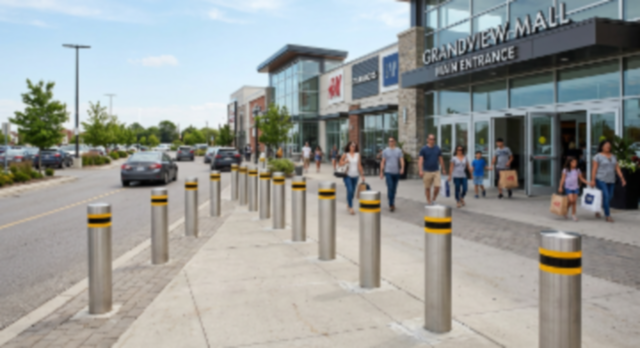
They are also used for flexibility. Most hotels or commercial properties like malls have stainless steel pillars installed at various locations: in front of the main gate, on escalators, or even outside showrooms in some cases. The zinc powder coated steel ones are shiny and look aesthetically good in locations where you want to appeal to customers or showcase class.
2. Safety Bollards For Outdoor
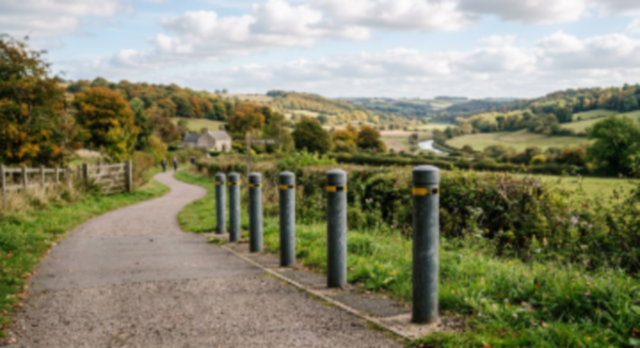
They have unique use cases in outdoor settings. They act as an important layer in covering public or private properties from unauthorized vehicles. If you go for high-quality material, ideally an ASTM F2656 crash-rated product, it can secure your space from damage by speeding vehicles. They can be installed to secure pathways of any dimension.
If a pedestrian path is your priority, you need around 3-4 ft of space, while around 5-6 ft of space is needed for bikes. Hospitals generally keep around 10-12 ft of space for the entry of emergency vehicles.
(1) Bollards for Infrastructure
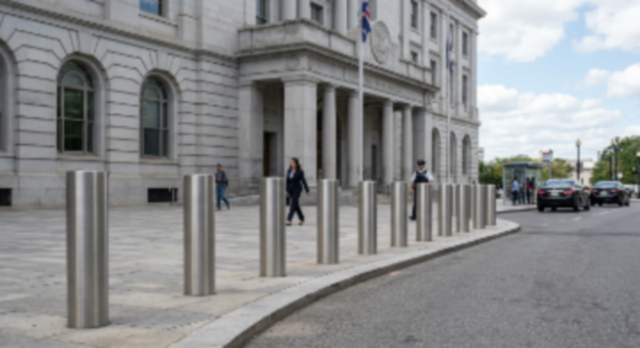
They are an important part of outdoor infrastructure. They protect key establishments from damage. Given their use cases and benefits, they are now used everywhere: schools, hospitals, airports, government buildings, and outdoor dining—you find them everywhere.
For sellers, they are a great opportunity to expand their offerings to these properties. There are many establishments where operators struggle with the above-discussed issues, but don’t know about the solutions. Educating them and offering services can open new doors for businesses.
(2) What are Smart Pipe Bollards?
They come in manual and automated forms, and are embedded with different technologies to serve various purposes. An automated retractable one can be operated via a remote control. There are IoT-connected barriers as well, which show real-time performance data. Smart ones also come with motion-sensor lighting and solar-powered technology. They are mainly used at high-risk locations, including government buildings, embassies, schools, and airports.
3. Heavy Use Case in Traffic Control
Police use them to manage vehicular traffic in busy areas or locations where many events happen. This helps them properly guide the vehicle flow. Barriers help create a boundary for vehicles, allowing pedestrians access to a traffic-free path. Estimates suggest that the installation of these pillars in critical areas reduces the number of fatalities. Police also use them with reflective stripes at night. To manage traffic, retractable ones are the most useful option as they can be used at different places.
(1) Use Case in Urban Locations
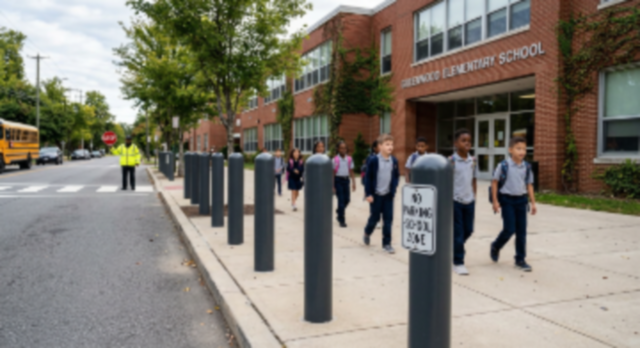
Most urban areas are heavily populated. Installing them to manage key structures—city centers, parking lots, school zones, construction sites, and stadiums—can be effective and time-saving. Some locations, like school zones, parking lots, or city centers, can have permanently fitted products, while retractable ones are useful in crowd management or areas where construction activity is going on.
(2) Compliance Standards
Countries follow different compliance standards to determine the quality of steel products. For example, ASTM F2656, a testing standard developed by the American Society for Testing and Materials (ASTM), is considered a hallmark of steel durability. The standard classifies barriers by vehicle type, speed, and penetration distance. PAS 68 is a standard widely used in the UK to measure the strength of barriers.
One can find PAS-certified items at all government buildings and other public places, such as airports, embassies, and stadiums. IWA 14-1, which is developed by the International Organization for Standardization (ISO), is considered an international standard for strength and durability. To be IWA 14-1-compliant, the products are subjected to different tests with vehicles hitting at different speeds. Some other standards are also used to specifically determine crash testing and public spacing requirements, including use cases for persons with disabilities.
4. Why Stainless Steel Offers More Than Just Defence
Steel barriers are used for safety, but they serve more than just that: they enhance architectural aesthetics. Stainless steel ones can be ordered in custom height or finish. For locations that showcase heritage, manufacturers are coming up with contemporary design options. Designs vary by location: whether it’s parks, shopping districts, or residential areas, bollards can come in different shapes and sizes.
(1) Where To Integrate Bollards
They can be integrated at places where safety is required: critical roads, schools, parks, government buildings, hotels, and shopping malls. For locations requiring smart setup, you should choose the ones that are fitted with motion-sensor lighting. In areas that are used every day, like metro stations, malls, or any public place, manual steel pipes can be perfect.
5. Choosing the Right Steel Manufacturer
Sellers must source these outdoor models from a trusted supplier who has a track record of consistently shipping quality units. An original equipment manufacturer can match your requirements by designing the model as per the demand. Hannah Technology in China is one of the biggest suppliers of outdoor steel items, includingpergolas, gazebos, and park benches. It specializes in bollards for sale across the US and European countries.
The company is a major manufacturer of custom models and has partnered with over 3,000 B2B buyers from different countries. Distributors eying bulk orders without compromising on quality should contact producers like Hannah. Businesses can pitch government authorities to install these products at critical locations, which can bring in more business for them. Before finalizing the distributor, you should verify their crash-test certifications and check their steel quality, including the thickness of the steel coating.
(1) Confirm Before Ordering: Surface Or In-ground?
Before placing the order, buyers should check the wind and impact ratings of steel pillars. They are installed either directly on the surface or in-ground, but it depends on your requirement. Lastly, ADA compliance should be a key criterion before finalizing a manufacturer.
(2) Hannah Technology’s Product Portfolio
Hannah Technology is aleader in galvanized steel products. Customers can place orders for either standard designs or customize by providing drawings. The company deals with all kinds of outdoor products and provides services at all stages: from designing and prototyping to the delivery of the products.
FAQs
(1) Q: What is a stainless steel bollard?
A stainless steel bollard made from steel alloy, which is generally considered corrosion-resistant. Everything you see around you: parks, buildings, metro stations, malls, all have stainless steel bollards. They are shiny, so gives a polished appearance, and require less care as compared to iron and rubber products.
(2) What are steel bollard posts used for?
Steel ones are used for traffic control, safety outside stadiums, or event locations. They can be used for crowd management, mainly at busy roads, schools, or business centers. They are also increasingly being used for landscape design and safety purposes. These products can last up to 30 years, with occasional maintenance.
(3) Are heavy-duty steel bollards durable?
Top-quality steel ones can last a minimum of 20 years, though with proper upkeep, the lifespan can be extended to 30 years. Experts advise using galvanized steel coating to ensure maximum protection, along with regular yearly inspection. Sourcing from atrusted manufacturer provides you with maximum surety on durability. They offer a specific warranty on products that are rated high on quality standards.
(4) Which type of bollard is better: fixed or retractable?
The type depends on the use-case. If you want permanent protection and do not require moving them from one place to another, go for fixed ones. Retractable ones are largely used to manage vehicle access, or to rush at crowded places, so they can be installed at highly populated locations. Find your use-case and then decide on which types can be used at your location.
(5) What crash rating do I need?
For quality bollards, the ASTM F2656 rating is the highest, especially in North America. If you are buying in the UK, ensure the product passes the PAS 68 standard. For global ratings, IWA 14-1 serves as the international standard. Crash ratings are crucial to determine the quality and overall lifespan of an item. Reputed manufacturers adhere to the crash-testing guidelines, which is why it’s important to do a background check on thesupplier before committing to the order.
(6) Can bollard covers be used for landscape?
You can customize them for a landscape. A manufacturer can design them with different heights or colors, lighting, and bollard covers. Decorative bollards can enhance the aesthetics of an area. In addition to providing security, these posts also enhance the aesthetics of a location. For people in the outdoor manufacturing business, every new construction site or up-and-coming public place can be a potential customer, as they’ll eventually require these products to support public safety and maintain an orderly environment.
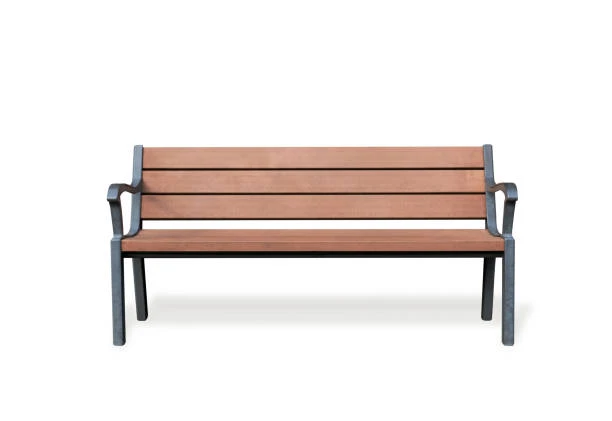
Cast Iron vs Steel For Personal or Commercial Bench: Which Outdoor Park Bench Lasts Longer?
The choice between a cast-iron seat and a steel park bench seat is difficult: both have the same use case, and they both give a similar aesthetic look when installed in a park. The difference comes down to how they behave when installed outdoors. There are tons of blogs debating which option is better: cast iron vs. steel park benches, but honestly, each has its own advantages and disadvantages.
If your house has a traditional appearance, cast iron can suit the outdoors perfectly because it is heavier and gives a heritage aesthetic. Steel, for a metal bench, is stronger under load. It is easier to treat and works better in all types of weather.
Some people looking for cost-effective alternatives also go for backless or thermoplastic options, though quality and durability are what differentiate a good product from a bad one.
In this article, we’ll explain how these two metals perform differently outdoors and how they rate on other important benchmarks like outdoor bench durability, cost, and climate suitability.
1. Cast Iron vs. Steel: How Garden Benches Differ?
As you finalize which metal will suit your outdoor durability structure, you should first understand the key differences between them. These two metals are completely different materials. They have different costs, durability standards, and maintenance requirements. These metals also undergo different manufacturing processes.
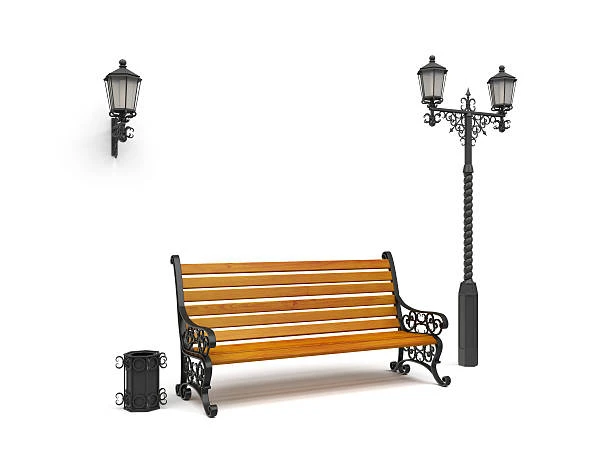
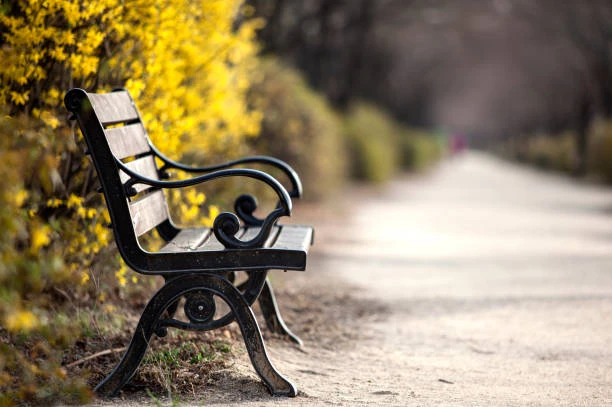
Cast iron is a refined form of melted iron. Once melted, the iron is poured into a mold. If your preference is for heavier structures with compressive strength, cast iron can be a good option. In many areas where the preference is for a traditional look, people prefer cast iron benches for parks.
Steel, which is a refined form of iron only, is also a great option if you are planning to install durable benches, which give aesthetic look. Steel has better molding capabilities than iron — galvanized steel, powder-coated steel and stainless steel — and people can choose as per their preference and budget.
(1) What Makes Cast Iron Benches Unique
Buyers consider cast iron for two reasons: its weight and appearance. Iron is one of the heaviest metals. A typical park bench weighs around 80-120 kgs. If fitted properly, it’s a one-time investment for a long time. Since cast iron can be molded, there are several design options that people can choose before finalizing the product.
You can also select cast iron if you live in areas where theft and vandalism are concerns. If you choose Hannah Technology, the company specializes in cast-iron park benches. Hannah Tech’s bench products are not only sturdy, but they also come with various design options.
Cast iron is cheaper than steel, and many customers prefer it for its longer lifespan. However, it has also come with disadvantages. Cast iron is brittle as it contains around 4% carbon content. So if there’s high impact, it just breaks or shatters, unlike steel, which may bend rather than fracture in such situations. Some people also prefer a bench without back or a concrete bench, which is a cost-effective way to install the product.
(2) What Makes Steel Park Benches Different
Steel is the workhorse of the commercial outdoor park bench furniture industry. It’s widely used across both commercial and public seating purposes, and personal properties, making steel an ideal material for park benches. Steel can bend but not break in an impact situation. Customers typically choose powder-coated steel for park benches, which provides both strength and durability.
The extra layer provides extended durability and enables different color coating options. Galvanized products are suitable for all types of weather conditions: they are water-resistant and reduce the impact of intense heat or snow. For a commercial bench, steel is an ideal material that lasts for years. Some people also go for recycled plastic benches or plastic benches, which do not last even two years if the area is prone to harsh weather conditions.
The only disadvantage of steel is damage to its coat. People should use good-quality powder for coating, which lasts longer and protects the steel layer from corrosion.
2. Comparison of Cast Iron and Steel on Durability and Lifespan
Most B2B buyers have only two concerns when looking for a manufacturer: Can the company’s cast iron products guarantee long-term durability, and what lifespan can they achieve? Let’s compare both cast iron and steel based on longevity.
(1) Cast Iron Longevity
Investing in a cast-iron product is often a lifetime investment. It generally lasts for decades — up to 50 years in some cases — provided the metal quality is high. There are areas in Europe and the US, where parks that are maintained by governments have cast-iron benches installed more than 30 years ago. These benches are still strong to this day and appear structurally sound.
It’s an undeniable fact that cast iron will need more maintenance. You have to repaint them after every one or two years if the location is humid. If you live in a dry area, the duration of maintenance, especially painting, can extend up to 3-4 years. But moisture is really a dampener for cast iron, and its coating must be protected to increase its lifespan.
(2) Steel Longevity
The performance of a steel depends upon the area where it’s installed: if it’s in a personal space, it’ll last longer, up to 30 years. In commercial spaces, there’s less care and more usage, so its lifespan will automatically reduce to 15-20 years.
Experts say that you should treat steel in a multi-stage process — first, it should be galvanized and then coated with zinc powder — to ensure bare steel does not get exposed to rain or heat.
If your budget is tight, you may also find several options online. Those willing to install a new one may be willing to put park benches for sale.
3. Cast Iron Vs Steel Comparison In Different Weather Conditions
Outdoor conditions can vary greatly, and if the material is not strong enough, the structure won’t last. The same applies to garden benches. You need to assess your outdoor conditions carefully before choosing the metal.
(1) Rainy, Humid, and Coastal Areas
Treated steel is naturally a better performer in wet and coastal conditions. Untreated iron can become a wasted investment in places where salt air and constant moisture are common. Galvanized steel, on the other hand, protects the metal over the long term and requires less maintenance than iron.
In these conditions, salt acts as a rust accelerator. Moisture tends to react better with iron, causing earlier decay. Powdered metal benches are less likely to get impacted in humid conditions. Choose high-quality zinc powder for steel and keep on maintaining it after regular intervals, as per the advice of your seller. The product will last better in coastal or rainy areas. Cast iron should be avoided in such climate conditions.
(2) Cold and Snowy Regions
Coated steel works better than cast iron in cold and snowy regions as well. Cast iron weakens in colder temperatures due to repeated freeze-thaw cycles. Cold hardens the metal and can break it under constant stress.
Consistent harsh weather – snow or low temperature – can make it rigid, leading to corrosion. The only advantage of an iron bench in snowy conditions is that snow melts faster on iron than on steel due to the material’s thermal conductivity.
Steel with a coated layer protects the metal from reacting to snow, proving the best option if your budget allows.
(3) Hot and Sunny Climates
Both steel and iron react to heat. After some time, the coated layer also starts shedding, affecting the inner layer of steel. To protect the metal for a longer period, you can carry out double coating, choosing the white color for better absorption of heat. If you are using benches in your personal space, keep them covered during the daytime if you are not using them.
In these regions, both cast iron and galvanized steel products perform almost the same. Applying a single or double light-colored powder coating helps reduce the impact of heat.
4. Maintenance Comparison Between Steel and Cast Iron
(1) Upfront Cost
When buying a product, a galvanized steel product will typically cost 25% higher than a cast-iron or a hybrid steel frame. Compared to the molding and casting processes required for iron, steel is generally less expensive to produce.
(2) Long-Term Maintenance Cost
Steel is definitely a better option for long-term investment. Galvanized steel treated with high-quality powder coating gives the metal the necessary strength to withstand outdoor environments. You generally won’t require more maintenance than a yearly cleanup and periodic inspections for coating erosion.
Cast iron can prove to be more expensive over time. The product structure will require repainting every 2–3 years if you want to prevent rusting. The upfront cost difference can become irrelevant over 20 years if cast iron products require regular treatment. So, a well-specified galvanized metal wins when it comes to long-term maintenance.
5. Which One Should You Choose?
You have to keep three things in mind before finalizing the material to be used in your bench: budget, location, and aesthetic requirements. Don’t just buy based on cost analysis only, because cheaper products can cost manifold in the long run due to regular maintenance requirements.
(1) Choose Cast Iron
Cast iron is cheaper than galvanized coated steel, so that’s one advantage. Traditional look and maximum design options are other benefits of having a cast-iron bench product. It’s also sturdier than steel if outside conditions, heavy snow or rain, are not playing spoilsport. If you live in places with a temperate climate with low humidity, you can go for a cast-iron bench structure.
Some manufacturers, like Hannah Technology use hybrid designs for benches. You get cast iron bench legs with galvanized steel. This way you get the strength and flexibility of iron and the modern look of steel.
(2) Galvanized Steel is Better
For long-term use, treated steel may provide better value because it reduces maintenance requirements. For B2B buyers managing multiple bench installations at public or commercial sites, this can become a major cost saver because it requires minimal upkeep.
Galvanized metal benches are also preferred in wet, humid, coastal, or cold climates.
Hannah Technology, one of the largest outdoor product manufacturers in China, is one of the biggest manufacturers of outdoor products in China. Its major offerings include benches, bollards, fences, and pergolas. Hannah ties up with B2B distributors and individual customers and provides custom-designed products based on customers’ requirements. The company boasts of around20 years of experience in making outdoor products and ships its products to around 30 countries worldwide.
FAQs
(1) I am buying a park bench. Which metal should I choose?
If you are buying a bench for your personal space. Galvanized steel is the best option if your house has a modern architecture. If your house has a traditional design and the outside area also demands a traditional look, and weather conditions are also not harsh, you should go for cast iron.
The only thing you need to keep in mind is regular upkeep. Though steel will require less maintenance over time, you should repaint the iron product every 2-3 years.
(2) Steel or Iron: Which metal rusts faster?
Cast iron is more prone to rust than steel. Steel can be protected using a coating. You can also paint iron as well, but the metal generally holds moisture, leading to corrosion after a few years.
(3) I live in coastal areas. Can I buy cast-iron benches?
You should go for treated steel or a hybrid structure if you are living in a coastal or humid area. Cast iron may not be suitable for such climatic conditions, as salt air reacts with iron, causing corrosion.
(4) Which one is heavier: a cast-iron or steel?
Cast iron is heavier than steel. A typical cast-iron bench weighs around 80-100 kg, as compared to a steel bench that weighs around 40-70 kg, depending upon your requirements.
Custom Aluminium Pergola vs Kit: Which Is Worth Your Money?
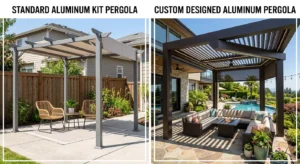
Choosing between a custom aluminum pergola and a simple pergola kit can be difficult, as both have advantages and disadvantages. A standard pergola kit comes with no hassles. It gets you started quickly, plus they are not very expensive. A custom aluminum pergola, on the other hand, allows your imagination to become reality.
The exact measurements, as per your space, give your pergola the structure it requires. A customized aluminum patio roof is always more durable and lasts longer than roofs made from other materials. In this article, we will explain exactly how these two differ. We will also compare these two on other key parameters like cost, quality, customization, and installation.
1.How do Custom Pergola and a Kit differ from Each Other?
As you decide on a particular pergola drawing for yourself, you should know the key difference between the two. A standard pergola kit, as the name suggests, is a pre-engineered kit, just like any other product that you buy online. It’s manufactured in such a way that it is easy to assemble its components, even if you are not ready for assembly.
Everything from posts, beams, rafters, hardware, and instructions — the entire design is fixed. When buying, you can choose the size of your pergola kit, but you can’t change the structure. Like any custom-designed product, a manufacturer will first understand your space requirements and then suggest design options via drawings. Once the plan is ready, you will get the final product as per your exact specifications – column thickness, roof design, louvre system, and finish.
(1) How Standard Kits Work
Standard pergola kits are designed for the mass audience, who want a quick-fix solution for their home. Such pergolas are not priced high, and entry-level aluminum pergola kits from a well-known manufacturer will come with a warranty. Many products also have motorized louvres these days. For a typical standard design, a 10×13 commercial-grade pergola weighs around 227 kg.
Even if you don’t have any prior experience, you can assemble a pergola with a little help in labour work over a weekend. Such products are engineered for mass production at the factory. You will likely find similar standard products at your neighbour’s house as well.
(2) How Custom Aluminum Pergolas Work
People prefer customized products as they don’t want their outdoor pergola structure to look like everyone else’s pergola. So, first, you contact a reputed pergola manufacturer. You share your measurements and requirements. Once you submit your drawings to the manufacturer, they come up with refinements and changes as per design trends.
Once everything is finalized, you get the custom structure, built specifically for you. Companies like China-based Hannah Technology manufacture customized aluminum pergolas for distributors and buyers worldwide. With regards to time, company-built products are manufactured based on your preferences and requirements, and the delivery timeline can vary on your design and order volume.
2. How Do They Compare on Cost?
Price is one of the main reasons people like to buy a standard pergola kit. Such products are generally 2–3 times cheaper than customized products. However, if we compare these two on different benchmarks like durability, strength, optionality, and elegance, a standard pergola is no match for a product that’s designed specifically for you.
(1) The Real Cost of a Standard Kit
A standard pergola kit comes in different price points – starting from cheap to pricier variants. Mid-range products start offering sophisticated functionalities like motorized options. But they are built to fit market expectations, not specifically you.
Most companies follow similar standards for standard products: they have fixed column thickness and powder-coating quality. Wind ratings may vary according to the price points. If cost is a key factor, it’s okay to go for a standard kit.
But make sure the product’s wind ratings are high. Do not settle for products that are optimised for mass production because the upfront cost may seem low, but you could end up replacing them in five years.
Budget kits come with a five-year structural warranty, which clearly tells you the confidence even manufacturers have in such products.
(2) The Long-Term Value of a Custom Aluminum Pergola
The custom aluminum pergola is costlier. Regardless of size or specifications, you have to invest 2–3 times more in a custom-made pergola structure. There are several positives associated with custom products.
First is the warranty. Manufacturers like Hannah offer a 20-year warranty for such products. This is clearly four times the coverage offered with standard products.
A commercial-grade custom pergola, which is manufactured according to your needs and specifications, is more elegant. It blends perfectly with your house, extending it seamlessly to the outer garden.
Customer reviews suggest that those who buy company-built pergola products see fewer replacements. Plus, if one considers installation, labour, and maintenance costs over 20 years, a customized pergola will bear less cost than a standard pergola.
3. How Do They Compare on Customization and Design?
Standard products typically give you a few options in customization and design.
This is where custom pergolas win decisively. Standard kits give you limited choices — usually a fixed column size, a set beam profile, and a small selection of standard colors. Custom builds give you complete control.
(1) What You Can Customize in a Factory-Built Pergola
Pergola manufacturers can customize each component of your outdoor product as per your needs. You want long columns and thick beams? It can be done. You can choose louvre designs from a whole array of options. There are multiple options in pergola roof designs as well. Vented structures, color and powder coat finish, integrated drainage systems, and LED lighting – all of them can be customized. You are paying for specifications, design, and elegance. Companies that are producing OEM and ODM orders can build structures exactly as per your requirements.
Customized pergola structures are always in high demand from affluent buyers and commercial spaces – hotels, outdoor dining areas, and residential developments.
(2) What Standard Kits Offer on Design
Standard aluminum pergola kits are of fixed dimensions. They are manufactured for mass production. Size and color options are generally limited. If you are serious about the durability of your design, ask about the return policy in advance. Sometimes, the standard pergola design may not fit perfectly due to unusual footprints. Many buyers initially go for standard designs and eventually realise their house requires a customized product due to specific aesthetic requirements.
The quality difference between a budget pergola and a factory-designed structure is significant and measurable.
For example, weight is the first clear gap. A customized pergola product can weigh up to 800 kg. A mass-market product of a similar dimension weighs much less, around 200 kg. The weight defines how sturdy and durable your pergola structure can be. More weight means thicker extrusions, bigger posts, and better structural integrity.
(1) Wind, Rain, and Snow Ratings
If you live in a windy area or harsh climate conditions, wind ratings should matter to you. A budget kit comes with a typical range of 72 to 80 mph wind speed rating. Its snow load rating is generally between 8 and 10 psf.
Custom-grade aluminum pergolas have higher ratings and can handle up to 130 mph wind speed and up to 65 psf snow load. You can think about a standard kit if the weather conditions in your area are normal. But it’s best to go for a custom-built structure if the outside weather is rough throughout the year.
(2) Powder Coat Quality
Most people don’t like to change their pergola every other year. A pergola should not lose its elegance and strength even in 10 years. The powder coat quality used on the metal will determine that.
Standard single-stage powder coat on a budget pergola model will start fading in three to five years. You can ask for multi-stage powder coating in your premium pergola model. Such a coating will resist UV for 20 years.
Before you finalize a manufacturer, specifically ask about their coating process. A standard single-stage coating will look dated in the first year itself.
5. Which Should You Choose?
Your requirement will define which pergola design you should install. There are many models in the market. You should choose a product that fits your specifications.
(1) When a Standard Kit Makes Sense
A standard kit will make sense if you want your pergola structure up and running in days, not weeks. Your house has the perfect slope. Weather conditions in your area are generally mild – most of the year it’s sunny, the region receives mild rain, and there’s barely any snowfall.
Another key factor is budget. If you have a limited budget and don’t want to spend too much on the pergola kit, a standard design should make sense. A kit model will easily give you a five-year warranty.
(2) When a Custom Aluminum Pergola Makes Sense
A custom-built structure should make sense if your outdoor space has non-standard dimensions. If you are buying it for a commercial property, a hospital or a residential project.
You want specific material quality, column thickness, and powder coating. You want at least a 15–20 year warranty. If you are buying directly from the manufacturer, it saves you money on dealer or distributor margins, meaning you can spend the extra money customizing your product.
Manufacturers likeHannah Technology, with around 20 years of experience in outdoor aluminum products manufacturing, are major suppliers of standard and aluminum pergolas to over 3,000 suppliers across 35 countries.
The company primarily manufactures aluminum alloy materials, alongside galvanized steel products. The company’s other major product offerings are bollards, fences, and outdoor structures.
FAQs
(1) Is a customized aluminum pergola worth the extra cost?
Yes, it’s worth your money if you don’t want a standard kit to fit your house. A custom drawing gives you exact dimensions, better material quality, and long-term durability. Over the course of a full lifespan, considering renovation expenses, a custom pergola costs less compared to a standard kit.
(2) How many years does a standard aluminum pergola kit last?
A budget model can easily last 5–10 years, depending on the material used. If you are looking for durability in a standard kit, don’t go for a lower-range kit. A mid-range design with quality powder coating and heavier columns can last longer.
(3) Can I set up a custom aluminum pergola myself?
No, it will require professional help. Custom pergolas are generally heavier and more complex than standard models. It’s recommended to hire a professional to install it, especially if your structure is above the standard size. For a DIY setup, you can go for standard designs.
(4) What size custom aluminum pergola should I get?
There are no specific sizes in customized products. It can be designed exactly as per your needs. The space requirement determines the size of your custom model. A manufacturer will draw the product as per your supplied drawings.
(5) Where can I find a reputed custom aluminum pergola supplier?
Experience matters a lot when you look at outdoor product manufacturers. They have ratings, product line-ups, and customer testimonials to show the quality of their products. A trusted supplier will give you a clear warranty on structure and finish at factory pricing.
Why Galvanized Steel Gazebos are the Smartest Outdoor Investment For Hardtop Roof
A galvanized steel gazebo is quite popular among people looking for a modern outdoor shed. Galvanized steel solves corrosion problems that arise with normal steel, making it an ideal outdoor gazebo material. Rust-resistant metal gazebos last longer, up to 30 years if taken care of well, and are cheaper than expensive metals like aluminum. A custom steel gazebo also gives you the flexibility to choose your material quality and overall structure. In this article, we will understand what makes galvanized steel the most stylish and functional high-quality material for building a gazebo for your garden.
1. How Galvanized Steel Compares with Other Materials?
Galvanized steel is a great alternative to aluminum. Some people prefer galvanized steel over aluminum because of its durability and superior strength. Galvanized steel outclasses aluminum on key benchmarks like wind resistance, snow load, and protection from rust. Galvanization, which involves coating steel with zinc, provides an extra layer of protection to the metal structure. Zinc coating blocks moisture, consisting of oxygen and water, from reaching the steel layer, making it suitable for areas with harsh weather conditions. Let’s see how galvanized steel is different from other outdoor living space materials.
(1) Galvanized Steel vs Wood Gazebos
Metal shines on two key parameters — maintenance and aesthetics. Zinc-coated steel will need minimal care and maintenance. High-quality treated wood is expensive and requires regular anti-termite treatment to prevent infestations. The rust-proof steel gazebo is heavy and is built for maximum strength. Wood provides you with a natural feel, deteriorates and decays over time under consistent exposure to sun, rain or snow.
(2) Galvanized Steel Gazebo or Aluminum Gazebos
Though aluminum is a widely used metal inpergola lounge, gazebos,and other outdoor living gazebo materials, protected steel is a preferred choice for many. Those who want their structure to have weight and want to be strong and sturdy will likely go for steel over aluminum. The heavyweight structure of steel is more stable. It provides resistance to your hardtop gazebo from wind and snow. Aluminum has no rust issues. It has a natural oxide covering that makes it corrosion-resistant. Steel, on the other hand, requires zinc coating or galvanization to stop it from corrosion.
2. Why a Rust-Resistant Gazebo Saves You More Money Over Time?
A rust-resistant gazebo will save you a lot of money over time for a slightly higher cost than a soft top untreated gazebo, as it requires less upkeep. You will get a rust-resistant gazebo in both galvanized steel and aluminum. The choice between the two depends upon outside conditions, your taste and preferences. The initial cost of installation is higher than, let’s say, wood or untreated material, but it’s worth it as it saves you from recurring maintenance costs. The expected lifespan of a treated metal or aluminum gazebo is much higher than any other alternatives out there, which gives you higher resale value as well. Here’s why a zinc-coated steel gazebo is worth your money.
(1) Galvanized steel requires low maintenance
The quality of treated steel is on par with aluminum, and both require minimal maintenance as well. Once you install the structure, you don’t need to wash it regularly, and an occasional wash is enough to keep it shiny and clean. Like wood, you don’t spend money on products like wood preservatives or anti-termite chemicals. In the long-run, you’ll rarely require replacement of its parts, so if you don’t change your mind for 20 years, your coated steel gazebo will stand firm.
(2) Coated steel has a higher resale value
Let’s be honest here. No one wants to live with a pergola or gazebo structure forever. Like your body, your house also needs consistent revamp to keep it as attractive and comfy as possible. So, if you install a zinc-coated steel gazebo today, and five years down the line you decide to change it, you’ll get better resale value than wood or vinyl structures. On one hand, a powder-coated steel gazebo has a shorter lifespan of 2-5 years, and a rust-resistant metal structure will last for the next 20 years without much attention.
3. How Galvanized Steel Gazebo Performs in Various Weather Conditions?
As we discussed earlier, climate conditions are a deciding factor in the material you should be using in your outside shaded structure. If you live in an area with heavy snow or high wind, or summer heat, a metal gazebo will provide maximum strength and stability.
(1) Heavy snow and high wind regions
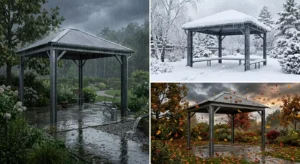
Steel is the best material for an outdoor gazebo if you live in a snowy terrain. Galvanized steel can hold a heavy snow load up to 30 inches. The sturdy metal columns can hold your structure for a long time. The sloped roof pitches make sure snow falls off easily, protecting the steel from erosion. Steel is heavier than aluminum so it can withstand up to 110 mph of wind speed.
(2) Sunny, humid and rainy areas
Steel is most effective if you live in sunny regions and need shade. It keeps the area under the roof cooler than a vinyl structure. To stop metal from conducting heat, you can always go for a double roof design. Steel manages to do well in humid and rainy seasons as well, thanks to its zinc coating that protects against rust and corrosion.
4. Custom Steel Gazebo vs Standard Kit — What Buyers Need to Know?
The standard kit comes in specific column sizes and shapes. You can decide on the material to be used, but the manufacturer provides the design. Customization costs 2 to 3 times as much as standard kits, but it’s worth it for a custom gazebo if you want strength and flexibility in material and design choice. You can compare these two choices based on cost, strength, customization choice and installation time.
(1) Custom steel gazebos are expensive
Custom-built structures cost roughly 2-3x than regular metal kits. If you have a low budget, you can choose the standard one, which will also give good durability. These kits come with specific instructions and easy-to-assemble parts, allowing you to DIY the setup.
(2) Customization allows you to choose the best material
Companies produce general size kits for commercial use, so everything from column length to metal thickness is optimised for maximum profit. Manufacturers sell their custom products with a 20-year warranty, while standard ones do not offer such a long-term warranty.
(3) Custom designs are more aesthetic and sturdy
Standard designs can’t match the look and feel of a custom gazebo shed, where you are personally involved in every detail — from choice of metal to color. Custom designs are more durable. Once installed, you likely don’t want to change it every third year. So, choose wisely. It’s always best to contact your outdoor spaces manufacturer for accurate advice on which material best suits your requirements.
5. Who can you trust for buying a coated steel gazebo?
After finalising the material, ensure it is coming from a trusted supplier. Check product descriptions on its website. Make sure the product you are buying has a high zinc coating thickness compared to standard ones, and its frame gauge is heavier. Some manufacturers also provide a warranty on finish and structure, so you must do some research before buying from local retail stores. Industry experts suggest it’s always better to directly contact factory sellers, who can provide top-grade quality materials without raising the cost too high. Keep these things in mind when purchasing a coated steel gazebo.
(1) Top-grade material and roof design
This is the foundation of a strong and durable structure. Coated frames are lightweight and can easily support a steel roof. For roof design, ask your seller for a double-roof or vented structure.
(2) Coating quality and climate ratings
The company should also ensure its steel products are properly treated to prevent rust. Some companies also show specific wind and snow ratings on their steel gazebo kit. Over 100 mph of wind speed and a snow load capacity of 30 inches is considered the best.
(3) Top gazebo manufacturer
A trusted manufacturer can provide you with quality products with a sufficient warranty on your gazebo kit. Hannah Technology in China, which is one of the most trusted players in outdoor products manufacturing, promises quality, customization and the best price. The company partners with distributors worldwide for both custom and standard designs.
Coated steel is Hannah’s flagship material, along with aluminum alloy products. Not only gazebos, a majority of its other products—such as pergolas, bollards, and fences—are constructed from treated steel, while some are made of aluminum alloy.
With a clear focus on the beauty, weather resistance, structural stability, drainage system, and timeless design of its products, Hannah boasts of superior craftsmanship and a deep understanding of outdoor durability requirements. The company, with over 20 years of experience in building quality outdoor area products, ships its products to over 35 countries and has served 3,000 distributors so far. So, if you are looking for custom metal roof gazebos and other outdoor products like pergolas, bollards and fences, you can contact the company by visiting their website: https://nexttest.hannahiron.com/products/
FAQs
(1) Is galvanized steel good for a gazebo?
If you don’t want to buy an aluminum structure, this is the best option to go with. Plus, coated steel costs less than aluminum, which is the most expensive material for outdoor products. Galvanized steel can last up to 30 years if bought from a trusted supplier. So, it’s clear that galvanized steel not only gives you quality but durability as well.
(2) Is galvanized steel weather-resistant?
Yes, it can protect the gazebo structure for years. Normal steel allows rain to react with the metal, resulting in early corrosion. The protective coating in galvanized steel does not allow moisture to cause an electrochemical reaction. A coated gazebo structure is a long-lasting investment. It is not priced high like aluminum but gives overall finish and feel like it.
(3) Is it cheaper to buy a gazebo kit or buy a custom one?
A standard gazebo kit costs 2-3x less than custom-built products. However, you need some knowledge about tools. A professional can install it quickly, but you will need to invest a lot of time making sure everything fits perfectly. On the flip side, hiring professionals can add to the overall cost. Add to it the labor cost and the overall cost goes higher. However, custom gazebo is what you prefer, a little high cost should not be a problem.
(4) Which is better — galvanized steel roof or polycarbonate?
A polycarbonate roof is cheaper than a galvanized steel roof and is easier to install if you are looking for DIY options. However, a treated steel gazebo gives a premium look and can last longer than a polycarbonate gazebo. On the flip side, galvanized steel is costlier and needs professionals to install the setup.
(5) What are the disadvantages of galvanized steel?
It’s not as appealing as aluminum, which offers a modern and premium look to your gazebo design. Galvanising steel also takes time and adds to the overall installation cost, causing delays. Its heavier weight also makes on-site installation more difficult compared to lightweight aluminum.
Why Choose a 20-Year Custom Aluminum Pergola Manufacturer
Finding a custom aluminum pergola manufacturer for your new business or existing business venture is an important choice. From developing initial trust to understanding how you can benefit from their experience, it’s a tough call. There are some key things that, if kept in mind, can help you determine who can become your B2B supplier for the long term. First among those is experience; the more the better. The second is the variety of customisation options it offers, and the third is the size of its operations. You must also consider factors such as their location and the key offerings of their factory. All of these points can help you determine the best partner for your business.You must also consider how partnering with a 20+ year experienced Chinese manufacturer can benefit you if you are launching a new venture in European and Western markets or looking for a new supplier.
1. Why Experience Matters in a Custom Aluminum Louvered Pergola Manufacturer
A B2B aluminum supplier with vast experience in making sturdy custom pergolas is a huge plus. Your OEM partner can help you focus on three key principles before you even start selling outdoor space products in your market.
(1) Quality of aluminum louvered pergolas
Metal pergolas are essential to any home. Those who want to buy a custom pergola tend to focus on quality more than anything. To ensure you are not compromising on quality from the start of your venture, it’s wise to look for a B2B supplier who considers quality and durability as part of their mission. Your potential customers, especially in Western markets, put key emphasis on quality. A reliable B2B partner will always explain in great detail their processes for ensuring quality: audits, testing, and regular innovation on customisation.
(2) Value for money for your outdoor living space product
This will determine how your wholesale business will thrive in the long run. If your OEM pergola manufacturer has vast experience, it’ll have established processes and optimised production systems. This means it does the heavy lifting for your business from the start: it sources quality material and invests in the latest R&D. This gives you better value for your money.
(3) Customisation capabilities like automatic roof
This is a big part of your relationship with a direct factory supplier. No one wants a generic pergola product. Each customer has their unique needs. From lighting options to different dimensions and designs, they want a pergola that’s a natural fit for their home. So, before you make the final choice, choose a custom manufacturer who can ensure you are not compromising on customisation. This either makes or breaks your business. Customisation sits at the heart of a pergola business.
2.What B2B Buyers Actually Need From an Aluminium Pergola Supplier
B2B customers rely heavily on their supplier for designs, quality, meeting customer requirements on installation, better profit margins, and great after-sales services. Here are some of the key things a B2B buyer wants from its pergola supplier.
(1) Latest outdoor space designs
As a B2B business, this is your moat. The better designs you can offer to customers, the better the word of mouth is, resulting in repeat buyers. A custom metal pergola manufacturer will always focus on innovative designs to build a lasting relationship with you. They can provide you with an extra competitive edge with vast design options and better features.
(2) Efficiency in producing the latest patio roof products
If you partner with an OEM that has vast experience in the industry, you get built-in processes. This results in efficiency. From consultation to approval of design options and final delivery, it’s a smooth process, not a haphazard back-and-forth discussion without tangible outcomes. So before you choose a direct factory manufacturer, make sure they have set processes: proper consultations, speedy production and timely delivery.
(3) Better market price and profit margins
A custom manufacturer with a decent market experience ensures you not only get the latest designs, smooth operation, handling service, but also good quality and competitive price. Such manufacturers put ‘trust’ at the heart of every partnership. If there’s higher trust in their business, they get more B2B partners. Quality is another important part: their choice of raw materials, advanced equipment, and rigorous checks lead to a better product at a highly competitive price. This can help you command high-profile margins on your products.
(4) Top customer service
Your pergola supplier is an invisible partner and mentor of your business. A reliable B2B manufacturer is with you at every stage. A reliable supplier with 20-plus years of experience will most likely have top customer service. Your journey with the supplier starts even before you buy anything: the way they handle pre-sale talks, their consistent communication, assistance during installation and post-sale services. Everything adds up to build trust with B2B buyers.
3. Custom vs Standard Aluminum Pergola: Why B2B Buyers Always Choose Custom Pergola Roof
A standard patio cover has limited buyers. People want to customise their aluminum louvered pergola as per space, home design and outdoor living conditions. There’s always a huge demand for suppliers who can offer customisation services. Here’s why B2B buyers always choose to partner with custom product suppliers.
(1) Flexibility in manufacturing
Designing a pergola product for your customer’s needs is a challenging task. Understanding customer requirements and delivering on them comes from years of experience in handling what exactly they are looking for. As a B2B partner, you have the flexibility to change requirements midway, add more features at any stage and promise a product that’s exactly how your customer imagined. That’s a real competitive advantage if you choose your B2B supplier wisely.
(2) Higher profit potential for custom pergola products
Customisation requires a lot more effort and understanding of designs and dimensions to add special features to your outside backyard structure. This means such a product will always fetch a higher profit margin for you than a standard design. A credible B2B supplier handles the critical part of design and manufacturing, and it’s win-win for both you and them.
4. How 20 Years of Manufacturing Experience Translates Into Quality
A trustworthy custom manufacturer with over 20 years of experience has a history of delivering products that meet customer expectations. They offer better customisation options than a supplier with just 5 or 10 years of experience. They even offer a better warranty period than their competitors.
Key benefits of choosing an experienced OEM partner are:
Trusted products
High-grade material
Vast design options
Customisation as per client requirements
Better support services
Your customers need proof of quality, customisation and delivery, not simple promises. A direct supplier with extensive experience always has strong testimonials to show. Their quality has also improved over the years through feedback and product innovations.
5.OEM and ODM Capabilities: What to Look For in a Pergola Factory
An original equipment manufacturer (OEM) makes products based on client requirements, while an original design manufacturer (ODM) handles the entire process from designing, engineering and manufacturing. Some manufacturers, like China-based outdoor products major Hannah Technology, also develop pergola models based on conceptual drawings. For your business, it’s always better to look for suppliers that provide both drawing and manufacturing services.
Here’s what both OEMs and ODMs offer:
(1) They have production capabilities
An experienced B2B supplier has a huge production capacity. Their factory can handle requests from various B2B pergola partners at the same time, without hurting quality. They have the required manpower and industrial capabilities to manage multiple clients.
(2) They have design capabilities
Whether you are in the business of aluminum pergolas or other metal shades, you want a B2B pergola supplier who can handle end-to-end design services: from conceptualisation to final product layout. Only an experienced pergola supplier with top design capabilities can showcase confidence to convert your imagination into reality.
(3) They ensure quality and the best customer services
A wholesale business works on quality and customer service. A new factory with a huge investment can fetch new buyers, but if its services are not up to the mark, customers will eventually leave. That’s why a genuine B2B pergola supplier will ensure its products are the best in the market and it offers consistent pre- and post-customer services. This leaves you, as a B2B partner, with a lot more time to focus on distribution rather than worrying about production.
6. Quality Control: What a Durable Aluminum Pergola Kit Manufacturer Looks Like
A serious manufacturer has superior craftsmanship and a deep understanding of what customers want. It provides cost-effective solutions without making any compromises in quality. As you partner with an experienced pergola manufacturer, a reputable company will prioritise what your customer wants, not what it can offer. So, look for these key things before finalising on who you are tying up with for your B2B outdoor products venture.
(1) Deep understanding of the market
A notable manufacturing facility like Hannah that specialises in aluminum alloy for outdoor structures has a deep understanding of the market. It has served customers across the Chinese and global industry for over 20 years, manufacturing around a record 2 million parts. The company ships its affordable outdoor products like pergolas, wrought iron fences, camping tables and outdoor chairs to over 35 countries. They have a vision to become the most trusted outdoor products manufacturer in the world.
(2) Strict quality controls
A serious player in the metal industry always ensures customers get high-grade material, which is not only durable but best value for their money. Brands like Hannah offer strict quality checks at every stage: top-grade aluminium, sturdy structure, and top-of-the-class features and specifications like adjustable louver, a unique LED lighting system, a sunlight protection system, and an in-built drainage or gutter system.
(3) They are always looking for serious B2B partners
Hannah is one of China’s growing manufacturers of outdoor products. It has a wide array of products that serve the needs of B2B customers across the world. Hannah especially focuses on its key markets like the US, UK and Europe. Customers looking for custom adjustable louvered roof, stainless steel and galvanised steel beam outdoor products suppliers can contact the pergola supplier by visiting their website: https://nexttest.hannahiron.com/products/
7.FAQs
(1) What should you look for in an aluminum pergola manufacturer?
A reputed and trusted custom manufacturer has decades of experience in producing top-grade outdoor products. They have the best customisation capabilities and production facilities. They apply rigorous checks and balances in ensuring the use of the best pergola material and offer 24*7 customer service for their B2B clients.
(2) Why is experience important when choosing a B2B supplier?
Manufacturers with 20+ years in the industry are more likely to deliver what they promise and fulfil customers’ complex requirements without pricing their products too high. They also have built-in processes to ensure quality at every stage: from conceptualisation to designing to manufacturing.
A B2B buyer in the outdoor product space typically looks for:
A company with vast experience
Built-in processes to cater to the custom needs of buyers
Efficient systems to ensure top-quality products
Strong customer support for their B2B partners
(4) Why do B2B buyers prefer custom producers over standard ones?
Customisation allows you to design a pergola as per your requirements. If you are a brand sourcing products directly from a supplier, you must partner with factory sellers that ensure flexibility in designs, production, and offer timely delivery of adjustable roof kits and, most importantly, high profit margins for your business.
(5) What are OEM and ODM capabilities in pergola manufacturing?
OEM (Original Equipment Manufacturer): An OEM offers you products based specifically on your requirements. They handle everything from design to manufacturing, making sure the delivered product is as per your customers’ requirements.
ODM (Original Design Manufacturer): An ODM handles the conceptualisation, engineering, designing and manufacturing of a particular product. They have the right teams and understanding to produce a product trending in the market. Such products are then rebranded by B2B buyers to cater to their customers.