Toughest Preferred Materials for Park Chair in High-Traffic Areas [Anti-Vandalism Guide]
The preferred materials for park chair must deliver reliable performance year after year.
Sites like transit stops, urban plazas, school campuses, and downtown parks deal with constant foot traffic, graffiti, physical impact, and weather that doesn’t take a break. Get the material wrong and it chips, rusts, or cracks fast. Get it right, and it stands up to vandalism, salt air, freeze-thaw cycles, and loads reaching 1,000 pounds without issue.
This anti-vandalism guide covers the six materials that actually survive high-traffic use: what they resist, where they fail, and how long they last.
Key Factors to Choose Preferred Material for a Park Bench
When selecting a bench for public areas, long-term performance determines whether it is a good investment. The following factors help buyers evaluate different materials before making a final decision:
- Yield strength and weight capacity, because they will determine how much pressure the bench can withstand without bending
- Hardness, which determines how the surface will resist knife or key scratches and general wear
- Corrosion resistance, depending on the environment, either marine or places where there is heavy rainfall and moisture
- Graffiti cleanability, rated from soap and water removal up to full repaint
- Flame spread index becomes relevant in places where there are fire sources, such as grills, roadways, or fire-prone areas
- Lifecycle cost, which balances cost and years of useful life
Each of these factors gets its own detailed look in the breakdown below, covering the specific numbers, ratings, and tradeoffs behind every bench material used in high-traffic public spaces today.
Preferred Materials for Park Chair: Technical Breakdown for Anti-Vandal Use
Here are the materials used in commercial park benches that actually last. We will talk about how each one resists damage, where it tends to fail, and how it performs under real testing standards rather than marketing claims.
Wrought Iron: A Proven Base Material for Public Seating
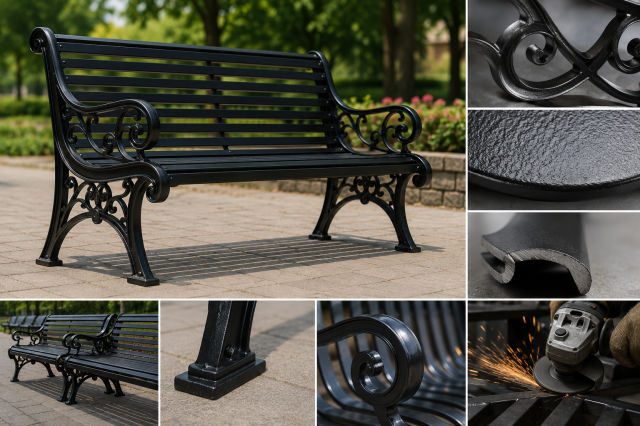
Wrought Iron has remained a reliable choice for public seating because of its strength, density, and ability to handle repeated stress. The material features a fibrous grain structure inside that prevents it from cracking when subjected to impact.
Wrought Iron has a yield strength ranging between 30,000 and 40,000 PSI, depending on the forging technique. This makes it very similar to the strength of structural steel.
Vandal data:
- Graffiti: Cleans up well once a rust-resistant coating is applied. ASTM D6578 ratings for this material are Level 1-2 when using polyurethane or epoxy finishes and can be cleaned up with solvent in less than 2 minutes.
- Impact: Impact strength measured using the Charpy test for quality wrought Iron is 20-30 ft-lb at room temperature, making it better compared to Cast Iron, whose impact resistance is below 5 ft-lb. 200 lb weight dropped from 4 feet does not crack but deforms.
- Fire: Fully non-combustible, posing no flame-spread risk at all. ASTM E84 Class A with a flame spread index of 0 and smoke development index of 0. Melting point exceeds 2,700°F, so surface charring is the only concern in extreme heat.
- Cutting: Rockwell B-scale hardness ranges from B60–B70. Knives skate on sealed surfaces, and power-tool cutting requires abrasive discs because of the fibrous slag inclusions that bind the blade.
- Weight: Typical bench frames run 120–200 lb before coating. This increases installed stability and discourages relocation without equipment.
Hannah Iron uses its own range of coating solutions for raw wrought Iron. We have over 6 types of coatings to protect the Iron from rust and any other form of weathering when used outside. This is what makes the difference between a bench made of wrought Iron that will last for 20 years and another that rusts within five years.
Installation costs of wrought Iron can be relatively high as compared to regular steel products. But longevity compensates for that in the long run.
Cast Iron with Wood Seat Inserts: Classic Strength Paired with Comfort
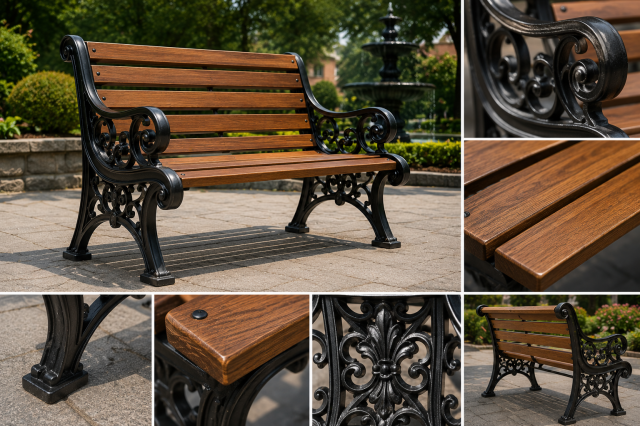
The combination of cast iron structure with wooden inserts for seating is one of the classic designs used in park bench manufacturing. This type of bench design can be seen in historic parks, gardens, memorial areas, and municipal projects where a classic appearance is preferred alongside structural stability.
The frame made of cast Iron takes care of structural load-bearing and prevents the possibility of theft due to its weight.
Vandal data:
- Graffiti: ASTM D6578 rating is Level 1–2 since the paint sticks to the non-porous material and can be removed using solvents in 1–3 minutes.
- Impact: Cast iron has high compressive strength, between 40,000–60,000 PSI, and low impact toughness, with Charpy values of 2–5 ft-lb.
- Fire: Iron poses zero fire risk. It is ASTM E84 Class A with a flame spread index of 0 and does not contribute fuel.
- Cutting: Iron cannot be cut easily. Surface hardness of cast Iron is about 170-220 Brinell (85-95 Rockwell B scale), which makes any cutting impossible by hand and possible only by abrasive discs.
- Weight: Sufficiently heavy to discourage theft without tools. Cast iron pieces usually weigh around 150–300 pounds each, while the total weight of the bench is 250–450 pounds, wood included. This adds stability to the installed piece and makes it harder to relocate by an unauthorized person.
Hannah Iron builds this exact combination as part of our product line. We pair cast iron strength with wood comfort in pieces like its Victorian-style scroll bench. Reapplying a wood sealant every year or two keeps the seat portion from cracking, while the cast iron base needs little beyond a coating check during routine inspection.
Powder Coated Steel: The Commonly Used Metal
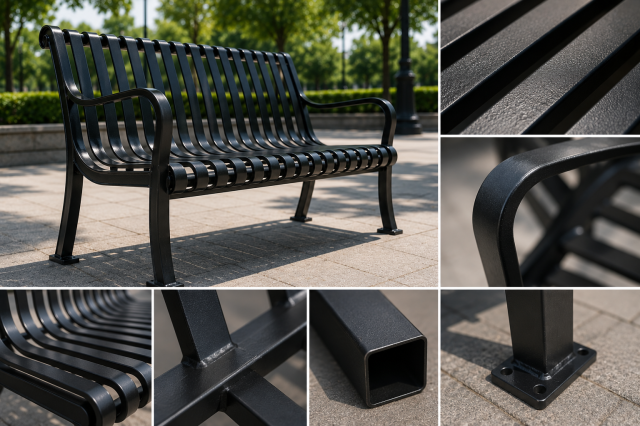
Powder-coated steel still tops the list of the most common metals used in making commercial park benches since it provides an economical combination of strength, cost, and versatility in design. The yield strength of this material ranges from 36,000 to 50,000 PSI, while salt spray resistance due to a proper powder coat application equals or exceeds 3,000 hours.
Vandal data:
- Graffiti: Cleans off easily with an anti-graffiti topcoat. ASTM D6578 ratings reach Level 1–2 on TGIC polyester powder coat with permanent urethane clear coat.
- Impact: Dents under heavy force but rarely cracks due to steel’s ductility. Charpy impact values for A36 steel are 15–20 ft-lb at room temperature.
- Fire: Fully fire safe, rated ASTM E84 Class A with a flame spread index of 0 and smoke development index of 0.
- Cutting: Hard enough to resist most knives. Rockwell B70–B80 hardness on the powder-coated surface. Abrasion resistance per ASTM D4060 is <50 mg loss with CS-17 wheel, 1,000 cycles. Power cutting requires abrasive discs or saws.
- Weight: Moderate, easier to install than Iron but less theft-resistant. Typical 6 ft bench frames weigh 80–120 lb. Total installed weight with slats runs 130–200 lb. Lower mass reduces freight and labor costs but allows relocation without equipment.
Steel is cheaper initially than either wrought or cast Iron, and therefore is a reasonable choice for lower-risk areas. Yet, it does not offer the same weight and anti-vandal protection that Iron provides.
Cast Aluminum: Most Suitable for Coastal Areas
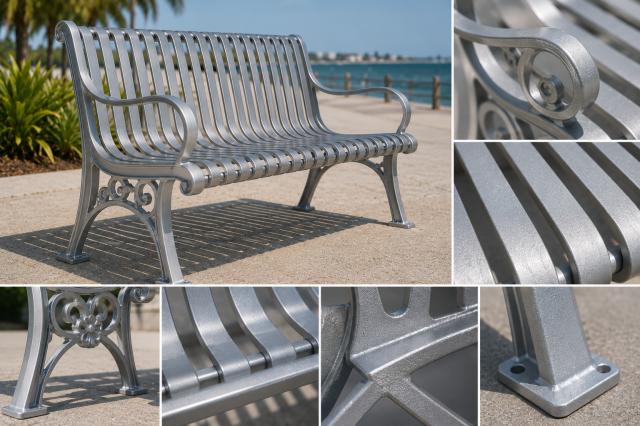
Due to its corrosion resistance capability, Cast aluminum is widely used in outdoor parks that are situated close to coastal and beach environments.
This metal does not have any iron in it and thus does not rust even if kept in humid conditions or air that has a lot of salt in it. Its tensile strength ranges from 25,000 to 35,000 PSI, which is much lower compared to Iron and steel but sufficient for regular public usage.
Vandal data:
- Graffiti: Cleans very well thanks to a non-porous surface. When finished with a polyester powder-coated topcoat, it achieves ASTM D6578 Level 1.
- Impact: Can crack under a sharp, concentrated hit due to lower ductility. Cast aluminum alloys like A356 have tensile elongation of 2–5% and Charpy impact values around 3–6 ft-lb.
- Fire: Fully fire-safe. ASTM E84 Class A with a flame spread index of 0. Aluminum melts at 1,221°F but does not ignite or contribute fuel load at ambient temperatures. In direct flame exposure, it will slump before combusting.
- Cutting: Softer than Iron, shows scratches faster. Surface hardness is approximately 60–80 Brinell, or Rockwell B50–B60. Abrasion resistance per ASTM D4060 is 70–100 mg loss with a CS-17 wheel, 1,000 cycles.
- Weight: Lighter, which slightly lowers theft resistance compared to cast Iron. Typical 6 ft bench frames weigh 45–75 lb, with total installed weight around 80–130 lb.
While aluminum may not match the impact strength of heavier metals, its combination of rust resistance, lower weight, and reduced maintenance makes it one of the preferred materials for park chair applications in challenging marine environments.
Recycled Plastic: Lowest Maintenance Option
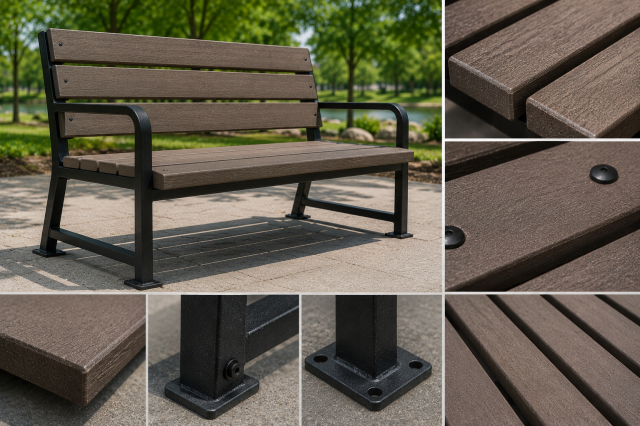
Recycled HDPE plastic neither rots, splinters, nor rusts and, therefore, maintenance is minimal when compared to either of the other two options. It generally requires some metal sub-frame in order to match commercial weight standards.
Its tensile strength normally ranges between 3,000–5,000 PSI, and its excellent resistance to impacts makes it bend rather than break under pressure. However, its lower stiffness compared with metal materials means proper frame support is required for commercial park benches with higher weight capacity requirements.
Vandal data:
- Graffiti: Wipes clean with basic cleaner due to a non-porous, sealed surface. ASTM D6578 ratings reach Level 1 on smooth HDPE boards.
- Impact: Good flexing and shock absorption. ASTM D256 Izod impact strength for solid HDPE planks is 3.5-4.5 ft-lb/in. It is highly elongated plastic and can stretch up to 400%-600% without breaking.
- Fire: Weakest point here, rated ASTM E84 Class C unless treated. Flame spread index runs 75–200 and smoke development exceeds 450.
- Cutting: Soft, carves easily, though damage stays local. Surface hardness is Barcol 35–45, or roughly 60–70 Shore D.
- Weight: Light on its own, needs a frame for theft resistance. HDPE density is 0.95 g/cm³, so a 6 ft bench seat with 2×4 boards weighs 40–60 lb.
Recycled plastic fits projects that prioritize sustainability and minimal upkeep, including schools, nature trails, and neighborhood parks. While it offers excellent resistance to water damage and decay, it is lighter than iron-based alternatives and may not provide the same level of security and permanence required for high-risk vandalism zones.
Bench Types and How Material Choice Changes by Design
It should be noted that not all benches are subjected to similar pressures. The section below describes different types of benches and what they require from the material used.
Backless Benches
Design demands: Backless benches take heavy motion all day, since people sit, stand, and jump on them without much thought. No back support means the frame alone absorbs sideways forces, so dynamic loads often run 1.5 to 2.0x the static weight, and longer spans require tighter deflection limits to avoid permanent set.
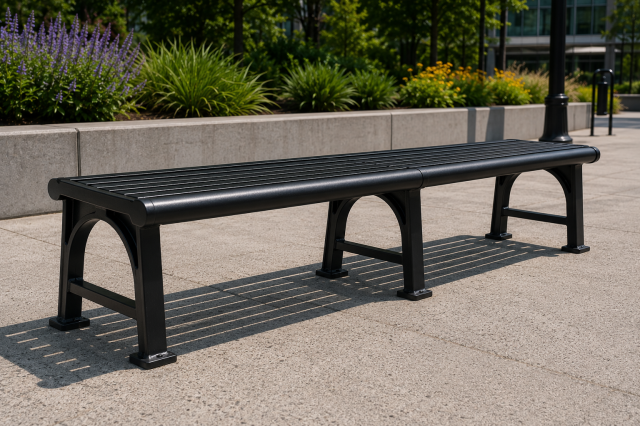
Material fit: 11-gauge to 7-gauge steel or thermoplastic-coated steel works best here, with yield strength around 36,000 to 50,000 PSI. Thin plastic bows in heat above 100°F, and cast aluminum can crack on spans over 6 feet. Iron holds up well thanks to its natural rigidity. At Hannah Iron, the backless bench capacity is specified above 800 lb.
Benches with Arms
Design demands: The arms serve a purpose other than making one comfortable. This design discourages lying on the bench and prevents skateboarding. Moreover, arms stiffen the design by completing the frame circle. Considering that the load is passed through the arm welds, the strength of the weld is as important as the material.
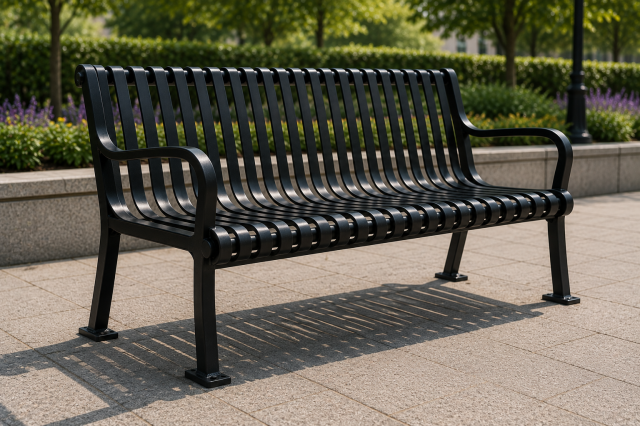
Material fit: Welding the arms to the frame distributes the load. Both powder-coated steel and aluminum are the right materials for the weld area. Also, Iron works well in the weld area because of the density and resistance of Iron to breaking. However, the recycled plastic requires a metal rod to be placed in the arm for support.
Curved Benches
Design demands: Curving makes a piece more visually appealing, but curving a structure adds stress, which isn’t present in a linear design. The cold process of shaping creates residual stress, while seasonal changes create a little bit of movement around the joints.
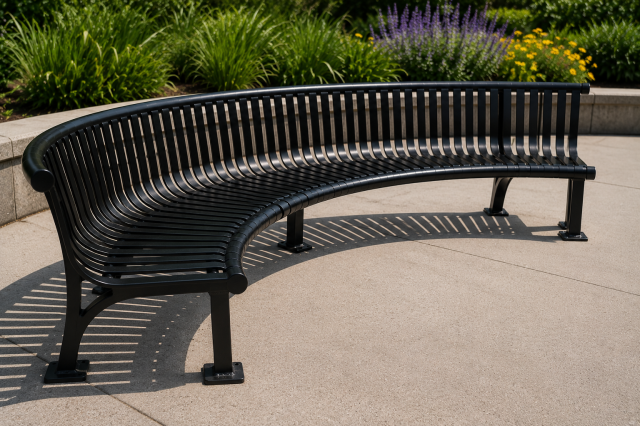
Material fit: Steel is easily shaped and retains its properties in spite of the curvature. HDPE has a tendency to deform when heated after being curved. Iron, just like steel, is easy to bend and retains its form long-term.
Wall-Mounted Benches
Design demands: The wall-mounted bench has no legs, meaning that the wall anchor and frame support the entire structure. All of the forces are concentrated on the points of attachment; thus, the wall becomes an integral part of the construction.
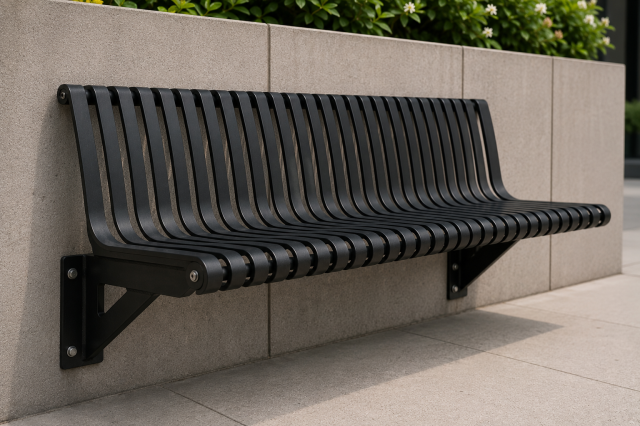
Material fit: Only steel and Iron would be suitable for such a design. HANNAH Iron uses heavy-duty steel angles, gusseted support brackets, and epoxy anchoring systems rated for 1,500 lb pull-out resistance to create secure installations that remain stable under repeated use.
Common Mistakes in Park Bench Selection
At Hannah Iron, we see people making mistakes every week that cost real money down the line. The first common mistake is picking wooden benches in downtown areas because of the beauty they possess. The problem is, wood needs regular sealing and upkeep — and downtown crews don’t have time for that. Without maintenance, the finish fails fast, and you’re left with a splintered, gray bench in two seasons.
Skipping anchors is another common yet costly mistake. A $900 bench that gets stolen can cost $1,400 or more to replace, with labor included, so tamper-resistant anchoring should never be skipped. Mixing metals causes problems as well, since steel bolts in aluminum legs trigger corrosion over time unless stainless hardware or proper isolation is used.
Heat also gets ignored more than it should. Dark metal benches in hot states can reach 160°F, hot enough to burn skin and keep people from sitting down. Buying on unit price alone causes the biggest long-term loss, though, since a cheap bench lasting two years often costs more over time than a pricier one built to last fifteen.
Quick Answers for Choosing the Right Bench
1. What is the most durable material for outdoor park benches?
Thermoplastic-coated steel and reinforced concrete are the most durable. Thermoplastic gives comfort and durability with graffiti resistance. Concrete gives maximum vandal resistance.
2. What is the best material for commercial park benches near the ocean?
Aluminum park benches are best. They are rust-resistant materials. E-coat powder-coated steel is second. Both handle salt air.
3. How do I choose the right bench material for low maintenance?
Pick recycled plastic park benches with metal frames or aluminum benches. Both need only washing. Avoid wood benches and plain steel. Lower maintenance means longer life.
4. What weight capacity do public spaces need?
Plan for an 800 lb minimum weight capacity. ADA requires 250 lb per seat. High-traffic sites should spec 1,000 lb. That covers groups and abuse.
5. Are metal benches too hot for outdoor spaces?
Dark colors, yes. Surface temps hit 150°F. Use light colors, perforation, or thermoplastic coating. That drops the temp 30–40°F.
Hannah Iron: Your Partner in Getting the Spec Right
Bench material selection rarely comes down to one factor alone. Weight capacity, corrosion resistance, graffiti cleanability, and lifecycle cost all pull in different directions depending on where a bench gets installed and how hard it gets used.
Getting this right the first time saves money and headaches for years afterward.
Hannah Iron works with park departments, schools, and property managers to build wrought Iron and cast iron seating suited to exactly these demands. We offer multiple coating options, tested load capacities, and custom manufacturing to help customers select benches correctly the first time, rather than being replaced after a rough first winter.
Have a project in mind? Contact Hannah Iron today, and let’s find the right material and bench type for your site before the order goes out.